
The Artemis Effect
A Deeptime reflection on moon joy, cosmic origins, and what it means to choose Earth

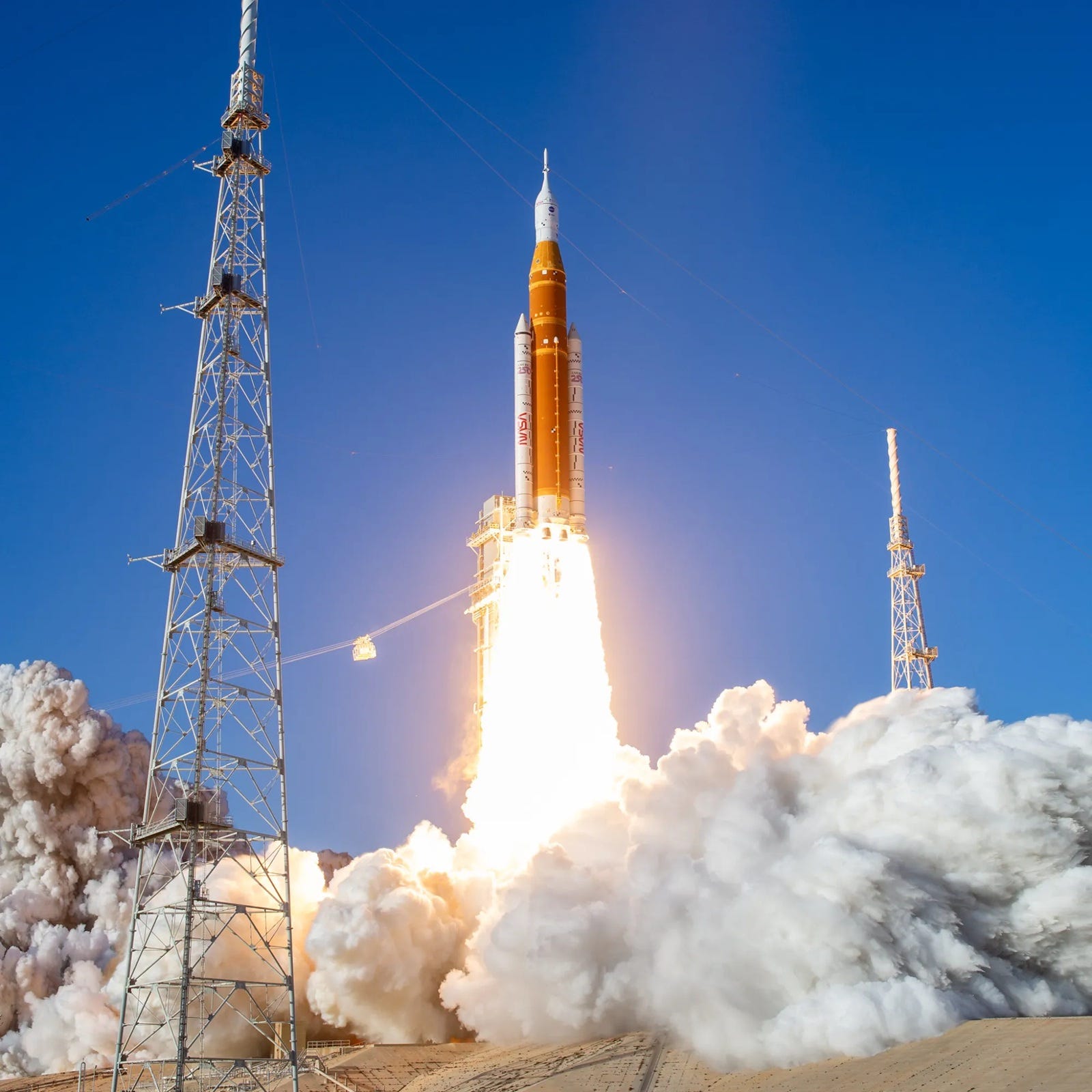
I watched as the rocket slowly rose on a column of orange fire. I have watched many launches over my lifetime, beginning with the early Apollo missions when I was very small, playing on the floor in front of the large cabinet television in our family living room. Later, I watched from our front yard in South Florida, binoculars trained on a distant glow nearly two hundred miles away, a tiny needle of fire pressing outward through the thin membrane of Earth’s atmosphere.
But this one was different.
The small capsule at the top of that roaring mountain of fire contained four humans headed for the Moon. That had not been done in a generation. Near-Earth orbit, while still an extraordinary technical achievement, has become almost routine. Commercial and military satellite operators do it all the time. There are even high school students in California who launch cosmic ray sensors atop large weather balloons to the very edge of space. In that sense, getting to space is no longer the impossible threshold it once was.
But going to the Moon is something else entirely.
It is not just higher. It is farther. Nearly 240,000 miles farther. To make that journey requires escaping Earth’s deep gravitational well and navigating with exquisite precision through a system in constant motion. The Earth turns. The Moon moves in its orbit. The spacecraft must find its path between them. If the trajectory is wrong, there is no gentle failure. The spacecraft continues outward into interplanetary space, where there is no refuge and no life. Earth is the only home we know.
So this was no small thing. To send human beings beyond the life-giving envelope of our atmosphere and beyond the gravitational embrace of our planetary home is a profound act of courage and capability.
And yet, it was happening.
Over the next ten days, I, along with millions around the world, found myself transfixed by the unfolding journey of these four astronauts. The word astronaut means star-sailor, and we watched as they sailed the silent ocean beyond Earth’s boundary. We watched them float in their small capsule, speaking with loved ones who grew more distant by the second, making precise navigational adjustments, brushing their teeth, fixing a broken space toilet, doing profoundly human things in a profoundly inhuman environment.
We are not made for space. Our bodies were shaped on the savannahs of Africa, our eyes and awareness attuned to horizons stretching across the Earth. Over time, we learned to stand upright and to reach, first for fruit, then for branches, then for mountains, and eventually for something beyond the sky. We called it heaven, another realm, yet somehow continuous with the upward arc of our becoming.
Like plants rising from the soil, drawn toward sunlight, life on Earth has always reached beyond itself. We, too, have emerged from the Earth, rooted in its gravity, yet oriented toward the vastness above. For most of human history, that realm lay beyond our grasp.
Until now.
There is another dimension to this journey that is easy to overlook amid the spectacle of flame and flight and the constant stream of live newsfeeds. The rocket itself is a kind of story, written not only in engineering and technical detail, but woven within the deep history of the universe. The fuel that carried those astronauts toward the Moon was made of liquid hydrogen and liquid oxygen. Hydrogen, the most abundant element in the cosmos, was born in the first moments after the universe began. Oxygen came later, forged in the interiors of stars and released through their deaths.
In that sense, this journey to the Moon was powered by the evolutionary momentum of the beginning and fueled by the ongoing creativity of stars. Inspired by the ancient Greek goddess of the Moon and of thresholds, the mission was named Artemis. In a very real way, this rocket was returning to the cosmic realm from which we had come. It was both an emergence from Earth and a return to our larger cosmic home.
To recognize this is to begin to feel the emergence of a new kind of awareness, what we might call a cosmic perspective. It is the realization that the materials of our bodies, the fuels of our technologies, and the vast environments we move through are all part of a single, continuous story. We are not separate from the Earth or the universe we explore. We are expressions of it. When we leave Earth, we do not step outside its boundaries. We extend it, like a living tendril of the cosmos reaching toward new possibilities of exploration and evolution.
But something significant happens when that recognition shifts from idea to direct experience.
Astronauts have long spoken of what has come to be known as the Overview Effect, a profound change in perception that arises when seeing the Earth from space. Floating in space, our familiar cultural and bodily orientation begins to loosen. Up and down lose their usual meaning. Heaven and Earth no longer sit in opposition. From that vantage point, the boundaries and borders that seem so solid from the ground dissolve. Nations disappear. Conflicts recede. What remains is a single, luminous world suspended in darkness, fragile and whole at once. It is not simply a new view. It is an entirely new way of seeing.
Looking out the window at Earth from space, Artemis astronaut Reid Wiseman reflected, “No matter how long we look at this, our brains are not processing this image in front of us. It is absolutely spectacular, surreal. I know there are no adjectives. I’m going to need to invent some new ones to describe what we are looking at out this window.”
This recalls cosmologist Brian Swimme’s suggestion that we may need new language to describe what we are discovering about the universe. The old words no longer suffice. We once thought of the universe as a place where things happen. What we are beginning to understand is that the universe is not a place or even a thing. It is an ongoing creative event.
This is what the Artemis astronauts began to experience together, four human beings in a small capsule moving beyond the familiar world of Earth and ordinary human perception. Like an arrow released from the bow of Artemis, they crossed a threshold into the wider field of the cosmos. The Moon was no longer a distant object in the sky. It became a place, a presence, a world unto itself.
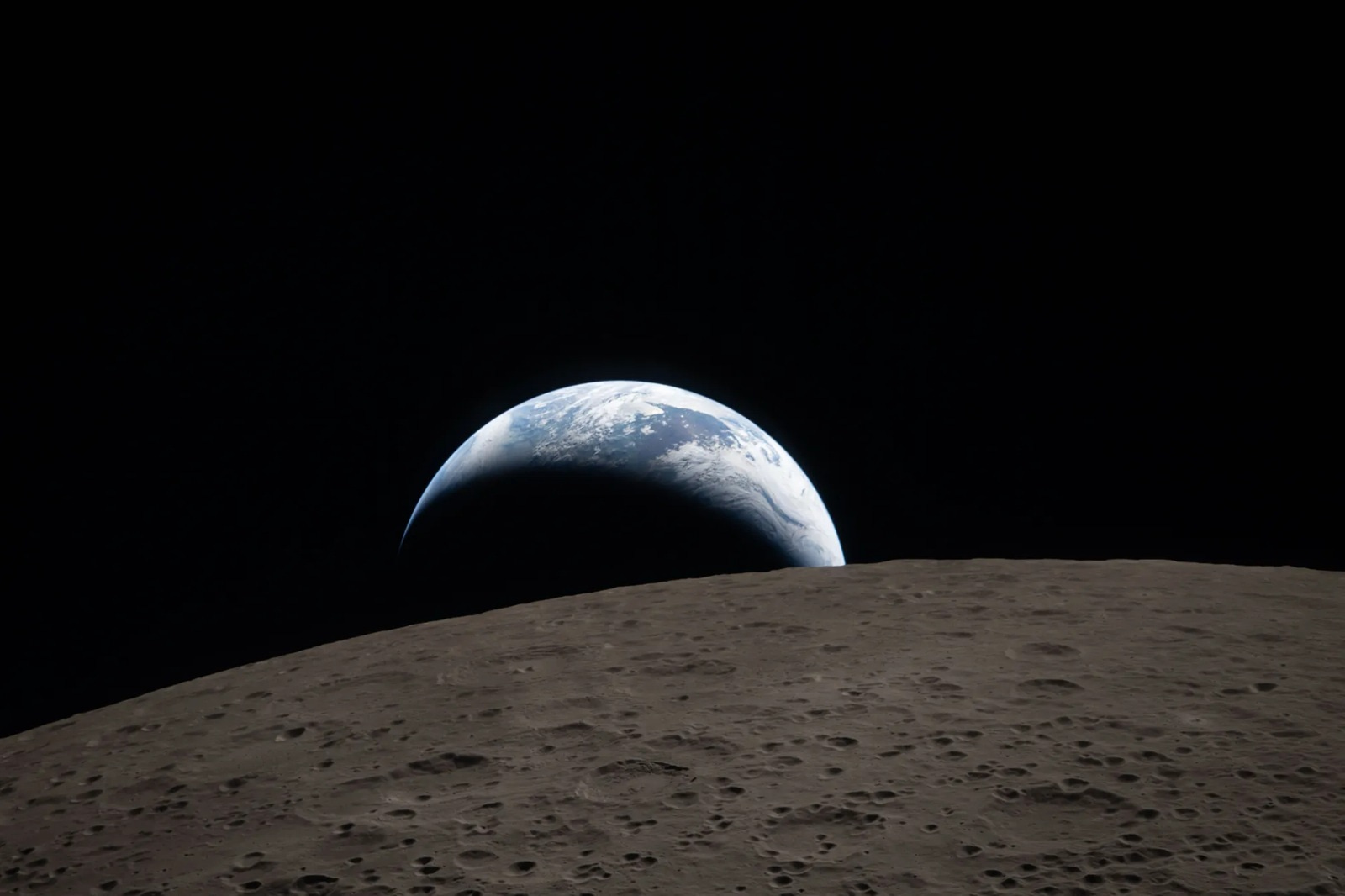
As they traveled farther from Earth than any humans in a generation, they entered into a shared experience of a larger context. Earth shrank to the size of a thumb held at arm’s length. The Moon grew to fill their windows and their awareness. And in that shifting scale, something shifted within them as well.
They called it “moon joy.”
In a very real sense, we experienced this joy as well. Through their eyes, we saw the Earth and Moon anew. In their voices, we heard a deepening sense of wonder and connection in how they spoke to one another and to our planet as a whole. They reached for phrases like “the mystery of love,” “lifeboat Earth,” “we’re all one people,” and “we love you from the Moon.” It was as if they had been immersed in a shared cosmic experience and were reflecting it back to us, shining it down like radiant moonlight.
This is what I would call the Artemis Effect.
The Artemis Effect is the experience of shared joy and wonder that arises when humanity encounters itself within a larger cosmic context. It is a unitive moment in which our usual divisions soften and a deeper sense of belonging begins to emerge. We recognize, if only briefly, that we are participants in a vast and unfolding universe, that we share a common origin, and that we belong here, together, on a single, fragile world.
Christina Koch expressed this experience when she said, “We will inspire, but ultimately, we will always choose Earth. We will always choose each other.”
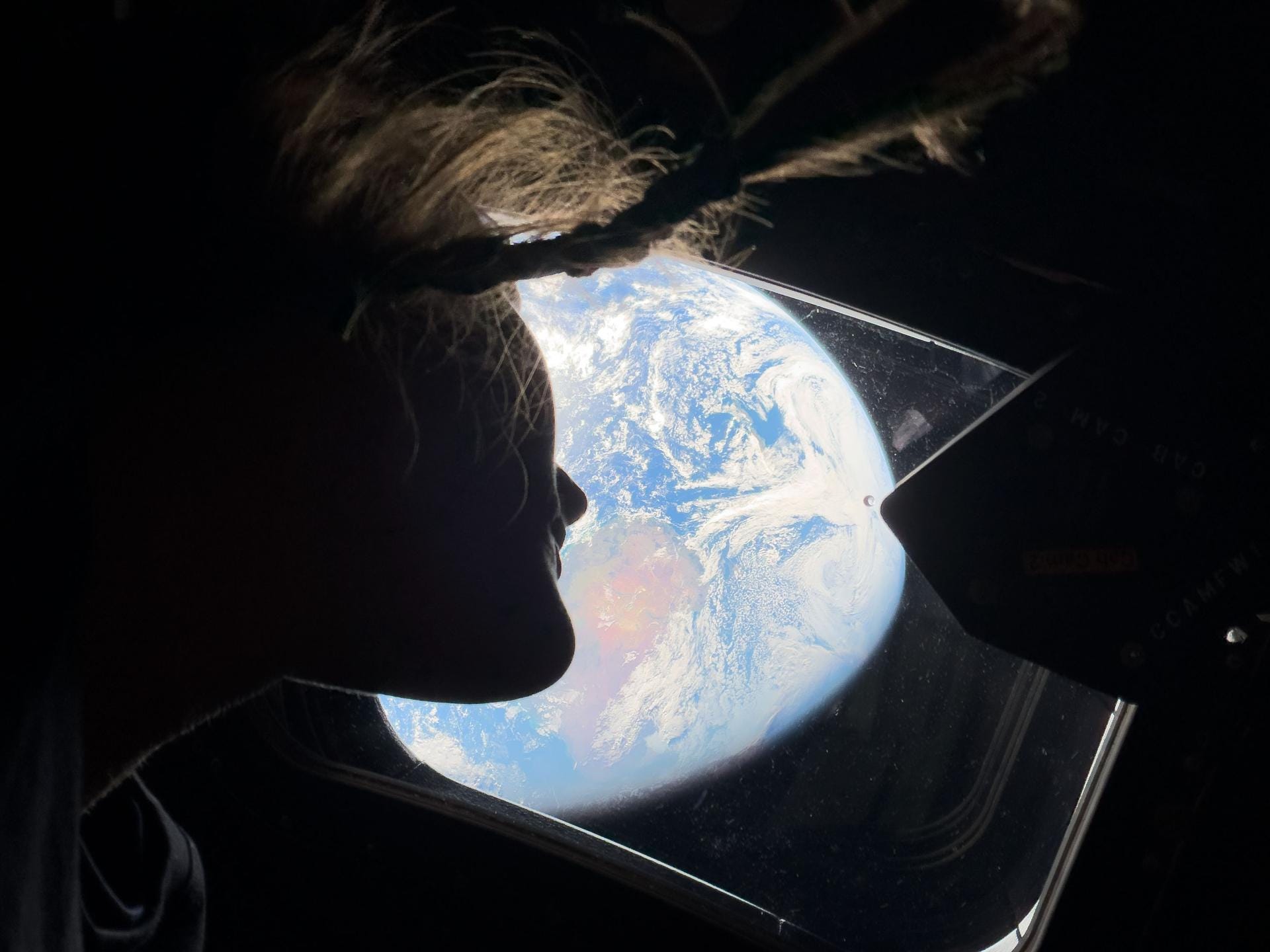
This is the Artemis Effect speaking from a Deeptime perspective. It includes our shared humanity, yet is illuminated by a deeper awareness of our cosmic origin, nature, and belonging.
It is not confined to space travel. It can arise whenever we step beyond the narrow frame of our daily concerns and allow ourselves to encounter the larger reality that holds and sustains us. A reality that has been unfolding for 13.8 billion years, arriving freshly in this moment and expressing itself through the infinite possibilities of now. Moments like this, when human beings leave the Earth and reflect it back to us from afar, have a unique power to awaken that awareness.
The challenge, of course, is that these moments pass.
The rocket lands. Our daily concerns return. The world settles back into its familiar rhythms and patterns. And yet something remains. Something has shifted, ever so slightly. An openness. A trust. A new possibility.
The deeper invitation of the Artemis Effect is not simply to witness these moments, but to live from them. To allow that expanded sense of perspective, that quiet awe, that shared belonging, to shape how we move through our lives here on Earth. To choose Earth. To choose each other. To choose love and belonging over separation.
We may not all travel to the Moon. But we can learn to see as if we had.
And perhaps the real return is not a place, but a new way of being.
Thank you everyone, for your thoughtful comments and reflections on The Artemis Effect. It's so mythopoetic that we named the mission Artemis, after ancient the goddess of the Moon and sister to mission to the Apollo missions fifty years ago (with Apollo the Sun god as the twin of Artemis). I think Teilhard would grasp the significance of all of this and would smile at what's coming forward now in our time.
I just finished reading Teiilhard de Chardin's Nostalgia for the Front in Sister Kathleen Duffy's American Teilhard Association's Reading Circle. Your reflection on the Artemis Effect illuminates and continues his thought. Thank you so much. I shared your article with my family.